Trip planningBangkok Guide
Best Time to Visit Bangkok: Weather, Rain and Crowds by Month
On this page

Which month should you choose?
We recommend January for a first visit built around temples, parks and neighbourhood walks: it combines relatively cool nights with little rain, without requiring a Christmas or New Year stay. December has the lowest rainfall and the lowest average daytime high. Both months still need shade breaks.
- Outdoor sightseeing: choose December or January. November and February also work, with warmer nights; November can retain showers as the monsoon retreats.
- Dates fixed in the wet season: June and July have lower average rainfall than August, September or October. Keep an indoor alternative beside each outdoor stop.
- Heat-sensitive travellers: avoid an itinerary dominated by walking in March, April or May. April has the highest average daytime maximum, 35.7°C (96.3°F).
- Festival trips: choose mid-April for Songkran, or the November full moon for Loy Krathong. These are reasons to accept crowds in particular streets and riverside locations.
- Cost-led trips: compare the same hotel and room conditions for June and September against your dry-season dates. Include flights, cancellation terms and airport transport before deciding; a rainy-season label does not establish a saving. For a stay with afternoon room breaks, choose a hotel base near the station serving your planned outings.
Bangkok weather by month
These are 1991–2020 climate averages for Bangkok Metropolis station (48455). High and low mean the average daily maximum and minimum; rainfall is the average total for the month. They describe a historical seasonal pattern, not the forecast for your holiday. Temperatures are in Celsius; 33°C is 91.4°F.
| Month | High °C | Low °C | Rain mm | Planning implication |
|---|---|---|---|---|
| January | 32.7 | 23.4 | 23.6 | Good for long outdoor mornings; high-season visitor demand. |
| February | 33.7 | 24.8 | 21.4 | Dry but warmer. Chinese New Year can concentrate crowds in Yaowarat. |
| March | 34.7 | 26.4 | 51.0 | Shorten exposed walks and put galleries after lunch. |
| April | 35.7 | 27.2 | 93.3 | Hottest average highs; Songkran changes access around water-fight streets. |
| May | 35.1 | 26.9 | 216.8 | Heat overlaps with the arrival of heavier rain. |
| June | 34.1 | 26.4 | 198.5 | Keep temple visits movable between days. |
| July | 33.5 | 26.1 | 189.7 | Rain remains a constraint despite less rain than September. |
| August | 33.3 | 25.9 | 227.1 | Choose accommodation with a short route to rail transport. |
| September | 33.2 | 25.4 | 335.9 | Wettest monthly average; a poor fit for a rigid outdoor checklist. |
| October | 33.0 | 25.2 | 288.7 | Still very wet; do not treat 1 October as the start of dry weather. |
| November | 33.1 | 24.7 | 44.6 | Much drier than October; riverside festival evenings can be busy. |
| December | 32.3 | 23.2 | 11.6 | Driest monthly average; Christmas and countdown dates attract demand. |
September has the highest rainfall total and December the lowest. October remains the second-wettest month in this record, so moving a rain-sensitive trip from September to early October is a weak compromise. Moving it to November changes the rainfall picture much more. September averages 21.4 days with measurable rain (at least 0.1 mm), compared with 1.5 in December. A rainy day in this count can include dry hours; it is not a count of days lost to sightseeing.
April and May combine high temperatures with warm nights; a room with air conditioning matters more than a packed afternoon schedule. The lower daytime highs of the wet season do not make it cool: humid conditions still make walking tiring.
What rainy season changes on the ground
Bangkok’s rainy season generally runs from May through October. Downpours can interrupt a day without occupying every hour, but rain can also be prolonged. Avoid building a plan around a promised daily shower time or duration.
In Reddit’s r/ThailandTourism threads “Would it be a waste to visit Thailand during September since this is considered peak rain season?” and “Going to Thailand in september/october. Bad idea? Tips?”, travellers praise quieter sightseeing and report trips with only a few heavy showers. Others describe rain at different times of day and humidity that takes getting used to. Their accounts explain why a flexible Bangkok city break can work; they cannot predict the weather for another visitor’s dates.
- Give each day one outdoor priority. Put the Grand Palace on the first suitable morning, with a second morning available if the forecast deteriorates. Do not lock every temple into the same day.
- Stay in one part of town during a storm. Move into a substantial building and wait before crossing the city. Heavy rain can flood streets and slow road traffic; a taxi ride is not a fixed-time connection.
- Keep height and water optional. Postpone exposed park skywalks, rooftop visits and river transfers during thunderstorm warnings. Follow staff instructions at piers and attractions.
Carry an umbrella or light poncho, a waterproof pouch for your phone and shoes with grip. Keep temple-appropriate clothes dry in your bag. Do not wade through floodwater to reach a booking: submerged drains and uneven paving are difficult to see.
Indoor alternatives that fit the route
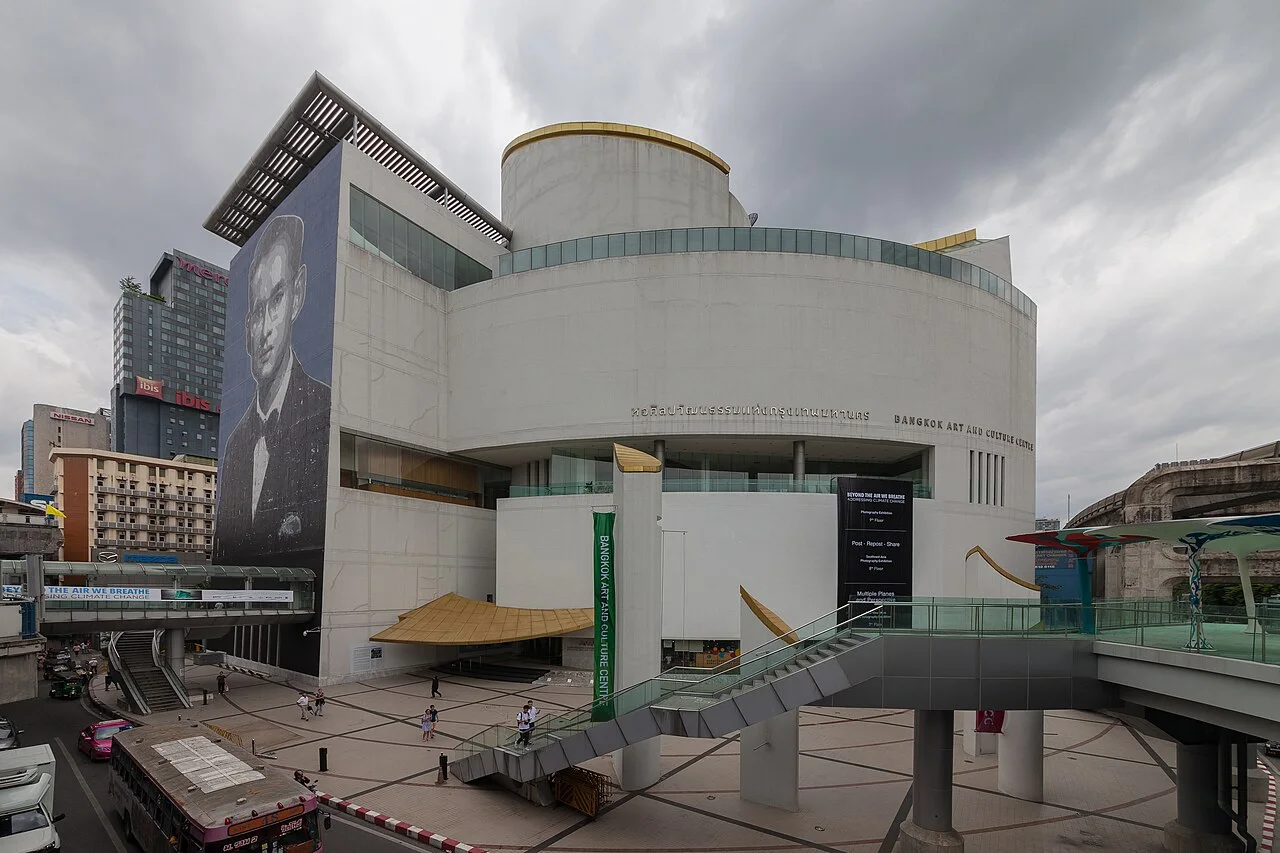

Choose the fallback before leaving your accommodation. Crossing Bangkok to escape a shower uses time that a nearby indoor stop could preserve.
- Siam and Pathum Wan: the Bangkok Art and Culture Centre beside BTS National Stadium opens Tuesday–Sunday, 10:00–20:00, with free admission. It works for a gallery afternoon after a morning outdoors. It is closed on Monday; use Siam Discovery or Siam Paragon for indoor dining and shopping that day instead.
- Khlong San riverfront: ICONSIAM provides indoor shopping and dining. From the rail network, use the Gold Line to Charoen Nakhon rather than making a boat journey essential to the fallback.
For the hot season, reserve 12:00–15:00 for lunch and an indoor visit as an editorial planning rule. Arrange outdoor stops around their actual opening times: the palace begins admitting visitors at 08:30, while Benjakitti Forest Park suits a separate early-morning or late-afternoon walk. Cooler hours still require drinking water and sun protection.
Crowds, festivals and dates to plan around
November–February is the main dry-season visitor period. Christmas and New Year add demand, but a month alone does not tell you how busy a particular attraction will be. Weekend markets, festival venues and royal ceremonies have their own patterns. A wet weekday and a festival evening can feel like different cities.
Loy Krathong: 24 November 2026
The next Loy Krathong falls on Tuesday, 24 November 2026. It centres on floating krathongs, with gatherings at waterways and designated park lakes. Choose a permitted public viewing area and follow its access arrangements; do not assume every stretch of riverbank is open. Bangkok is not the setting for Chiang Mai’s mass sky-lantern photographs.
New Year: 31 December 2026–1 January 2027
Countdown crowds gather around riverside venues and central shopping districts. If attending an event, choose your accommodation and return route around that venue. Do not base the journey home on an unannounced extension of BTS, MRT or boat hours.
Chinese New Year: 6 February 2027
The next Lunar New Year begins on Saturday, 6 February 2027. Yaowarat Road is a focus for celebrations; dense pavements and changed street access can make it a poor choice for a quiet food walk. The calendar date does not establish a Bangkok performance or road-closure schedule.
Songkran: 13–15 April 2027
The next Songkran holiday dates are Tuesday–Thursday, 13–15 April 2027. Water-fight areas such as Silom and Khao San Road attract crowds. Use a waterproof bag for valuables and keep a dry route for arrival with luggage. Book intercity travel early if leaving Bangkok around the holiday, and check individual venue programmes rather than assuming celebrations run on every street for all three days.
For the Grand Palace, check its access calendar separately from the national holiday calendar: ceremonies can change sightseeing arrangements. A public holiday is not a citywide closure notice.
Dry weather can coincide with poor air quality
Bangkok can have elevated PM2.5 during the cooler, drier part of the year. December–February are a particular concern in the city’s air-quality records. A dry forecast therefore does not guarantee clear skyline views or a suitable day for outdoor exercise.
Check the local station reading and health advice in Air4Thai before a long park walk or rooftop visit. If an alert advises reducing outdoor activity, switch to an indoor plan and avoid strenuous exercise outside. Treat air quality and rainfall as separate decisions; neither can be settled by a monthly climate table.
Other planning questions
Is Bangkok’s weather a guide to the Thai islands?
No. Check the coast and island separately before combining destinations. Koh Samui’s rainfall pattern differs from Bangkok’s, so a dry November city visit does not establish good beach weather there.
Should I cancel because my weather app shows rain on every holiday date?
Read the hourly forecast and warnings for Bangkok before changing the trip. A rain symbol alone does not tell you how much will fall, how long it will last or which part of the city will be affected. Keep cancellation deadlines in view while reviewing the forecast.
Is a hotel pool useful in the cool season?
Yes, if swimming is part of your plan: Bangkok remains hot during the day. Check whether the pool is shaded, its opening hours and any maintenance closure with the hotel; the season name does not tell you whether a particular pool will be comfortable.
Editorial information and sources
Prepared by the Bangkok Guide editorial team. Climate figures, calendar dates and the BACC fallback were checked on November 4, 2026. Route choices and the midday indoor break are editorial planning advice.
- TMD climate normals, 1991–2020, printed page 51: Bangkok Metropolis monthly temperatures and rainfall.
- Check TMD forecasts and weather warnings before setting out.
- Bangkok Environment Department annual report: seasonal air-quality observations.
- Bank of Thailand holiday calendar: select 2027 for the next Songkran bank holidays.
- Thai PBS 2026 lunar calendar: November full-moon date.
Keep exploring
Bangkok Street Food Guide: What to Eat and Where to StartWhere to Stay in Bangkok: Best Areas for First-Time VisitorsBangkok Art and Culture Centre