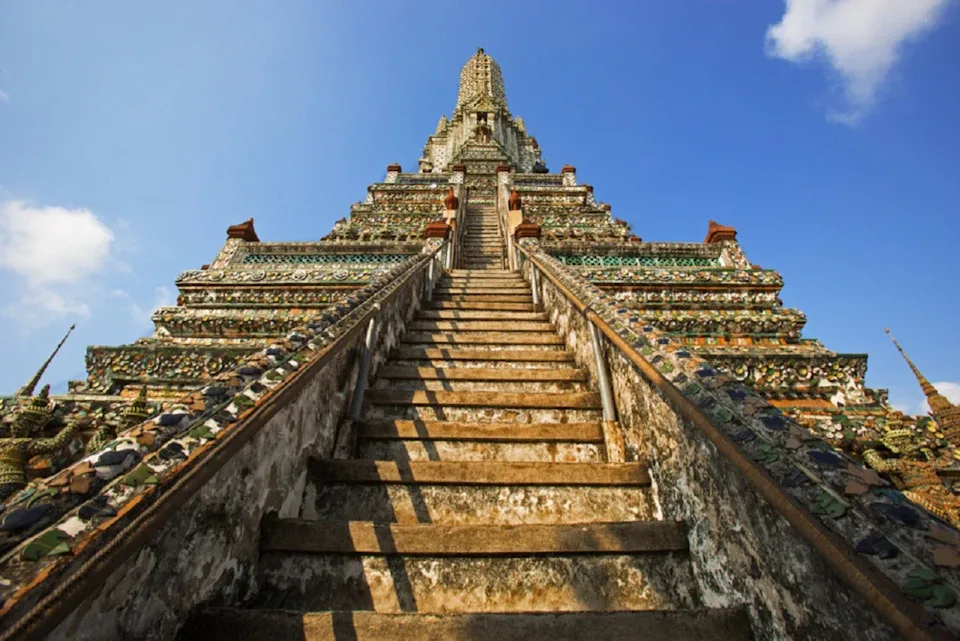
Wat Arun

Wat Arun

Why visit

Who will love it

[ { "attraction": "Wat Arun", "summary": "An iconic 17th-century riverside temple known for its 82-meter Khmer-style spire decorated with millions of pieces of Chinese porcelain and seashells.", "price_from": "200 THB", "duration": "1 hour", "best_time": "08:00 to avoid the midday heat or 17:30 to see the temple illuminate at dusk.", "booking_required": false, "district": "Bangkok Yai", "recommendation": "History enthusiasts and photographers should prioritize Wat Arun for its unique architectural style and its role as one of Thailand's most recognized symbols.

Unlike the gold-leafed temples across the river, this site offers a tactile, mosaic-heavy aesthetic that is best appreciated up close during the quieter morning hours.\n\nThose with limited mobility or a severe fear of heights may want to skip the climb, as the stairs leading up the prang are exceptionally steep and narrow.

If you are short on time and have already visited the Grand Palace, you can opt to view the temple from a riverside cafe in the Old City instead of crossing the river to enter the grounds.\n\nPro Tip: Use the cross-river ferry from Tha Tien pier for 5 THB to get the most impressive view of the temple as you approach from the water." } ]

Who should skip it

Not specified yet

What to know beforehand

[ { "Summary": "Wat Arun, the Temple of Dawn, is a 70-meter tall spire on the west bank of the Chao Phraya River, famous for its intricate facade encrusted with millions of pieces of Chinese porcelain and seashells.", "Body": "The temple complex is centered around a massive Khmer-style prang surrounded by four smaller towers.

While the highest levels are closed to the public to preserve the structure, the lower terraces remain accessible, offering a close-up look at the floral mosaics and mythical guardian figures.

Visitors must follow a strict dress code requiring shoulders and knees to be covered; sarongs are available for rent at the entrance for approximately 50 THB.", "Best time": "The gates open at 8:00 AM, which is the ideal time to visit before the heat and the large tour groups arriving by boat become overwhelming.

Alternatively, 4:30 PM offers softer light for photography as the sun begins to set behind the temple.", "Ticket block": "Entry for international visitors is 200 THB.

The ticket typically includes a small bottle of drinking water, which is helpful given the lack of shade throughout the complex.", "Prime timing block": "For the most iconic view, head to the opposite bank of the river in the Phra Nakhon district at sunset.

Watching the temple silhouette against the evening sky from a riverside deck is a quintessential Bangkok experience.", "Editorial Note": "Wat Arun is a masterpiece of texture and light, but the physical experience is demanding.

The white porcelain reflects the tropical sun, making the grounds feel significantly hotter than the surrounding city, and the remaining accessible stairs are exceptionally narrow.

It is a paradise for photography enthusiasts and those who appreciate architectural detail, but travelers who struggle with heat or steep inclines may find the visit taxing.\n\nExpert Insight: Use the 5 THB cross-river ferry from Tha Tien pier to arrive.

The approach from the water provides the best perspective of the temple’s scale and is far more scenic than arriving by taxi on the Thonburi side." } ]

Illuminated river boat passing Wat Arun at night

🎫 Tickets, tours & discounts

[ { "### Which ticket to choose": "For most visitors, the standard entry ticket purchased at the gate for 200 THB is the only option needed. This grants full access to the central prang (tower) and the surrounding ordained halls.

There are no tiered 'VIP' or 'Fast Track' levels for the temple itself, as the site is compact and managed through a single flow. \n\n- Standard Entry: Best for independent travelers.

Includes a small bottle of water.\n- Boat-Linked Tickets: Useful if you are using the Chao Phraya Tourist Boat (Blue Flag), which often sells a day pass that includes the pier stop but not the temple entry fee.\n\nA common mistake for first-time visitors is arriving without cash.

While some digital payment options are expanding, the ticket counters and the essential cross-river ferry from the Tha Tien pier (5 THB) primarily operate on cash. Ensure you have small denominations ready for the ferry and the entrance. \n\nImportant: The dress code is strictly enforced.

If you are not wearing clothes that cover your shoulders and knees, you will need to rent a sarong at the entrance for a small fee, typically around 20 THB plus a refundable deposit.", "### Best time to visit": "The most strategic time to enter the temple is at 08:00 sharp.

This allows you to climb the steep stairs of the central prang before the tropical heat becomes intense and before the large tour groups arrive from the Grand Palace across the river.

By 10:30, the narrow walkways around the towers become significantly congested.\n\nFor photographers, the 'Golden Hour' starting around 16:30 provides the best light for capturing the intricate porcelain details.

However, keep in mind that while the temple is named the 'Temple of Dawn,' the most iconic views of the silhouette against the sunset are actually seen from the opposite bank of the river, not from inside the grounds.

\n\n- Solo/Photographers: 08:00 for clean shots without crowds.\n- Families: Early morning to avoid the midday sun, as there is very little shade on the temple grounds.", "### Combos and discounts": "Wat Arun is a staple inclusion in the Go City Bangkok Pass and the Bangkok Explorer Pass.

If you hold one of these, your entry or a guided walking tour of the complex is typically covered.

There are no official 'combo' tickets sold at the gate that include the Grand Palace or Wat Pho; these must be purchased separately at each respective site.\n\nChildren under the height of 120 cm usually enter free of charge.

Thai residents with a valid Thai ID or driving license enter for free, but there are no specific discounts for foreign residents (Expats) beyond the standard tourist pricing.

If you plan to visit multiple riverside sites, the Chao Phraya Hop-On Hop-Off boat pass is the most efficient way to bundle your transport costs.", "### When a tour makes sense": "A guided tour is highly recommended if you want to understand the fusion of Hindu and Buddhist iconography or the history of the porcelain pieces—which were originally used as ballast on Chinese trade ships.

Without a guide, the intricate carvings and the meaning behind the giant 'Yak' guardian statues at the entrance are easily missed.\n\nHowever, if your primary goal is to admire the architecture, take photos, or rent a traditional Thai dress for a photoshoot (available at many stalls just outside the entrance), a self-guided visit is perfectly sufficient.

The site is small enough to navigate on your own in about 45 to 60 minutes.\n\nTip: If you are visiting the Grand Palace first, many licensed guides there offer 'Old City' walking tours that conclude at Wat Arun, which is a practical way to handle the logistics of crossing the river and navigating the crowds." } ]

View tickets

Weather nowOvercast sky
Bangkok, Thailand
NowOvercast ☁️
Temperature27°C
VisibilityGood
AerosolsClean air · AOD 0.18

Conditions are mixed — plan accordingly and check for covered areas.

AOD — how much dust and haze in the air dim the distant view. 0 clean, >0.4 noticeable, >0.7 heavy.

Crowd indicator

Expect heavy crowds from mid-morning through late afternoon, with narrow walkways becoming highly congested and significant bottlenecks forming at the ferry pier during sunset.

When to go?

Mini-calculator based on crowd levels by day and time.

Best time at Mon — 10:00

This day has average visitor density. This slot has a higher chance of a comfortable visit: Tour groups arrive. Weather is currently not ideal: overcast ☁️.

30–50% · Quiet60–80% · Moderate90–100% · Crowded

Nearest days

TodayStandard weekday crowds with a noticeable spike at the ferry pier around sunset.
10:0075%
12:0080%
14:0080%
16:0085%
17:0095%
18:0060%
TomorrowSlightly busier as the weekend approaches, especially in the late afternoon.
10:0080%
12:0085%
14:0085%
16:0090%
17:0095%
18:0065%
Day after tomorrowHeavy weekend traffic expected; arrive right at 08:00 to avoid the worst congestion on the stairs.
10:0090%
12:0095%
14:0090%
16:0095%
17:00100%
18:0070%

How to find the entrance

1
"Cross-river ferryTake the shuttle boat from Tha Tien Pier to the temple riverside landing.",
2
"Ticket counterPurchase your 100 THB entry ticket at the booth located near the pier exit.",
3
"Dress code checkEnsure shoulders and knees are covered before passing through the security checkpoint.",
4
"Main spire entranceScan your ticket to enter the central courtyard and access the porcelain-encrusted prang."

[ { "Address": "158 Thanon Wang Doem, Wat Arun, Bangkok Yai, Bangkok 10600", "Nearest metro": "Itsaraphap MRT Station (Blue Line)", "District": "Bangkok Yai", "Summary": "A landmark riverside temple known for its 70-meter spire decorated with intricate porcelain patterns and seashells.", "Entrance instructions": "Most travelers reach Wat Arun by taking a cross-river ferry from Tha Tien Pier, located on the opposite side of the Chao Phraya River.

The ferry costs 5 THB and drops you directly at the temple pier.

If you arrive by the MRT metro, you will enter through the land-side gate after a 10-minute walk from Itsaraphap Station, which is less crowded but less scenic than the river approach.\n\nOnce you disembark at the pier, the ticket office is located immediately to your right.

After purchasing your ticket for 200 THB, you will walk a short distance to the main turnstiles. The process is generally fast, but the flow often slows down at the gate where staff perform a mandatory dress code check.

If you are not dressed appropriately, you will be directed to a rental stall nearby, which can add 15 minutes to your entry time.\n\n- Queues at the ticket booth are common between 10:00 and 14:00.\n- Congestion occurs frequently at the base of the central prang (spire) due to the narrow, steep steps.\n- Bottlenecks often form at the ferry pier during sunset hours when many visitors depart simultaneously.\n\nImportant: Your shoulders and knees must be covered to pass the ticket inspectors.

Avoid wearing see-through clothing or tight leggings, as staff are strict and will require you to rent a sarong before entering the inner courtyard." } ]

Practical limits & what to bring

[ "### What to consider before visiting\n\nWat Arun is an active Buddhist temple with a strictly enforced dress code. Visitors must cover both shoulders and knees; sleeveless shirts, miniskirts, and ripped jeans are prohibited. Sarongs are available for rent at the entrance for 20 THB.

The site involves significant physical exertion in high heat with minimal shade.

The central monument features exceptionally steep, narrow stone steps that are challenging for those with limited mobility or young children.\n\n### Prohibited and permitted items\n\n- No drones or professional filming gear without prior authorization.\n- No tripods or large photography equipment.\n- No alcohol, cigarettes, or e-cigarettes.\n- No revealing or offensive attire.\n- Small backpacks and personal bags are allowed.\n- Water bottles are permitted and essential for staying hydrated.\n\n### Lockers and storage\n\nNo luggage storage facilities or lockers are available within the temple grounds.

Large suitcases are not permitted on the temple structures and are difficult to manage on the narrow, crowded walkways. Strollers are allowed in the main courtyard but cannot be taken up the stairs of the prang.

For those traveling with heavy bags, it is necessary to use storage services at the ferry piers or leave items at a hotel.\n\nTip: Wear comfortable, easy-to-remove shoes, as you must be barefoot to enter the internal shrines and the main ordination hall." ]

Location and what's nearby

[ { "attraction": "Wat Arun", "city": "Bangkok", "district": "Bangkok Yai", "location_context": "### What the neighborhood is like\n- A historic riverside district on the Thonburi side characterized by traditional wooden houses and narrow alleys.\n- Offers a much quieter and more residential atmosphere compared to the bustling tourist center across the river.\n- Perfect for old-town culture, temple hopping, and capturing the iconic Bangkok sunset from the waterfront.\n- High density of active Buddhist monasteries and small local communities living along the ancient canal networks.\n\n### Nearby on foot (up to 15 minutes)\n- Wat Kalayanamit — Massive seated Buddha statue in a quiet riverside temple · 12 min walk\n- Wat Rakhang Khositaram — Historic temple known for its bells and royal connections · 12 min walk\n- Santa Cruz Church — Historic Catholic church featuring a distinctive reddish dome · 14 min walk\n- Kudeejeen Community — Ancient Portuguese-Thai neighborhood famous for unique local cupcakes · 15 min walk\n\n### In 15–30 minutes by transport\n- Wat Pho — Giant Reclining Buddha and traditional Thai massage school · 10 min by ferry\n- Grand Palace — Former royal residence and the Temple of the Emerald Buddha · 15 min by ferry\n- Iconsiam — Massive luxury mall with a floating market food court · 20 min by boat\n- Museum Siam — Interactive exhibits on Thai culture in a neoclassical building · 12 min by ferry\n\n### Where to eat nearby\n- The Deck — Thai and international food with temple views · above average · reservation recommended · 5 min by ferry\n- Chom Arun — Traditional Thai cuisine with a rooftop sunset view · above average · reservation mandatory · 5 min by ferry\n- Home Cafe Tha Tien — Cozy family-run spot serving authentic home-style Thai dishes · average · can visit without reservation · 5 min by ferry\n- Rongros — Elevated Thai comfort food in a stylish riverside setting · above average · reservation mandatory · 5 min by ferry\n\n### Ready-made daily itinerary\nStart the morning at Wat Arun to admire the porcelain mosaics, then take the cross-river ferry to explore the Reclining Buddha at Wat Pho.

Walk through the vibrant stalls of the nearby flower market before heading to the Kudeejeen Community for a traditional snack.

End the day with a sunset dinner at Chom Arun to see the temple illuminated across the water.\n\nNote: Use the cross-river ferry at the pier next to the temple to reach the historic center in minutes." } ]

Reference

Facts

Read more

[ { "attraction": "Wat Arun", "city": "Bangkok", "country": "Thailand", "facts_block": "### Numbers and Scale\n- Height: The central prang reaches 82 meters, serving as a primary navigational landmark for river traffic on the Chao Phraya.\n- Porcelain Count: Thousands of individual pieces of Chinese porcelain and seashells are embedded into the plaster to create intricate floral patterns.\n- Structural Layout: The site features four smaller satellite prangs that surround the central spire, representing the four cardinal directions of the universe.\n- Staircase Steepness: The steps leading to the highest accessible terrace are inclined at nearly 60 degrees to represent the arduous path to heaven.\n- Foundation Depth: The structure is supported by a massive underground network of teak wood piles driven into the soft alluvial soil.\n\n### Myths and Misconceptions\n- Myth: The temple is best visited at dawn for the best views.

Reality: Since it sits on the west bank, the sun sets behind the prang, making sunset the peak photographic moment.\n- Myth: The porcelain decor was custom-made for the temple's exterior.

Reality: The ceramics were actually broken pieces used as ship ballast and recycled by King Rama III to save costs.\n- Myth: Wat Arun was built from scratch in the 19th century.

Reality: It originated as Wat Makok during the Ayutthaya era and was later renamed by King Taksin in the 1700s.\n\n### Rare and Unusual\n- The central spire is crowned with a golden 'Vajra' or seven-pronged trident, a symbolic weapon associated with the god Indra.\n- The ashes of King Rama II are interred at the base of the principal Buddha image inside the temple's main Ordination Hall.\n- The temple served as the temporary home of the Emerald Buddha for five years before it was moved across the river.\n- The base of the central prang features distinct rows of stone statues depicting ancient Chinese soldiers, monkeys, and mythical giants." } ]

Background

History

Read more

[ { "attraction": "Wat Arun", "city": "Bangkok", "history": "Wat Arun originated as a modest shrine during the Ayutthaya period, but its importance surged when King Taksin designated it as his royal temple.

It served as the temporary home for the Emerald Buddha, Thailand's most sacred image, before the capital was moved across the river.

This royal connection transformed the site from a local temple into a cornerstone of Thai national identity.\n\n### Porcelain and Trade\n\nThe temple is famous for its towering central spire, which stands approximately 80 meters tall.

The structure is intricately decorated with bits of colored porcelain and seashells that were used as ballast on Chinese merchant ships.

This unique ornamentation creates a shimmering effect at sunrise and sunset, giving the Temple of Dawn its name.\n\nBeyond its religious role, the temple serves as a monument to the architectural transition of the Thonburi and early Rattanakosin eras.

For the modern visitor, the steep staircases and detailed carvings of mythical guardians provide a physical connection to the craftsmanship of the past. Its silhouette remains the most recognized image of Bangkok worldwide." } ]

♿ Accessibility & families

{ "accessibility_flag": "Partial (Ground level only)", "child_friendly": "Yes, with supervision", "policy": "## Mobility and Wheelchair Access\nWat Arun is only partially accessible to visitors with reduced mobility.

The main courtyard and the grounds surrounding the base of the temple are paved and relatively flat, with ramps available to reach the ordination hall. However, the central prang (the main tower) is strictly inaccessible to wheelchairs and walkers.

The upper levels are reached via stone steps that are exceptionally steep and narrow, posing a significant challenge for elderly visitors or those with balance issues.\n\n## Families and Strollers\nChildren under 120 cm in height enter the temple for free, while those above this height pay the standard 200 THB adult fare.

Strollers are permitted on the general temple grounds, but they must be left at the base of the central tower if you intend to climb, as the stairways are too narrow and steep for any equipment.

For parents with infants, a baby carrier is a much more practical choice than a stroller for navigating the site.\n\n## Safety and Comfort Notes\nThe stairs on the central prang are the primary safety concern for families; they require constant adult supervision as the rises are high and the footing can be slippery.

There are no elevators on-site. To manage the heat and crowds, aim for a visit before 09:00. Note that the strict dress code (shoulders and knees covered) applies to older children as well; sarongs can be rented at the entrance for 50 THB plus a refundable deposit." }

🏢 On-site amenities

[ { "title": "On-Site Amenities", "restrooms": "Clean public toilets are located near the main entrance and the ferry pier.

A small maintenance fee of 5 to 10 THB is typically required for access.", "dining": "Arun Cafe is situated within the temple grounds, providing an air-conditioned space for Thai tea, coffee, and light snacks.

It serves as a casual spot to rest after exploring the steep central prang.", "shopping": "A dedicated gift shop and several stalls sell traditional Thai crafts, postcards, and souvenirs.

If your clothing does not meet the mandatory dress code, sarongs are available for rent or purchase at the entrance for approximately 50 to 100 THB.", "water_and_connectivity": "There are no public water fountains on-site, but bottled water is sold at the cafe and various kiosks.

Visitors should bring their own water to manage the heat. Public Wi-Fi is not provided within the temple complex." } ]

Reliability & freshness

UpdatedMay 21, 2026

I live in Bangkok and for the past seven years I have written practical guides on getting around, eating well, and planning days out.