Markets & shoppingBangkok Guide
Chatuchak Weekend Market: what to buy & how to get around
On this page
Is Chatuchak worth your weekend morning?
We would give Chatuchak three hours if you enjoy browsing clothes, homeware or art: that leaves time to compare shops and sit down for food. With only 90 minutes, choose one category and a snack. For a visit centred on eating, Or Tor Kor across Kamphaeng Phet Road is a more compact alternative; for shopping with air conditioning, ICONSIAM works on weekdays too.
Reader experiences explain the difference. In Reddit’s r/Bangkok discussion about visiting without shopping, one visitor enjoyed hours of looking despite buying only denim overalls and two coffees; another found the repeated merchandise unrewarding. In r/ThailandTourism’s discussion of a 90-minute visit, a recent visitor described spending a whole day walking without finding what they wanted. A short list of goods gives the visit a purpose.
Opening days: weekend shopping, plants and Friday trade
- Saturday and Sunday, 09:00–18:00: the main weekend market, including fashion, homeware and art. Individual shops open and pack up at different times within the trading day.
- Wednesday and Thursday, 07:00–18:00: the plant market. Come for plants and gardening supplies rather than a full souvenir-shopping visit. Plant trading also takes place on Tuesdays; Wednesday and Thursday are the straightforward choices for a dedicated visit.
- Friday evening, 18:00–midnight: the wholesale session, with a smaller selection of traders than at the weekend. Some sell individual pieces, but quantity requirements and prices belong to each shop.
For a first visit, we favour a Saturday or Sunday morning because it gives you time to browse while shops open, rather than racing a late-afternoon closure. A 10:00 arrival leaves time for shopping and lunch. An arrival at 16:00 suits a shorter browse, with less time to revisit shops or arrange packing.
Before a special trip, open the Chatuchak trading timetable and contact form. Holiday notices are also posted on the market administration’s announcements. Monday is not a day for the main market.
Free entry and optional guided tours
Walk-in visits need no reservation. A paid booking buys a guide or another listed service; it is separate from access to the market. For browsing a few sections, arriving independently by rail is sufficient.
A guide can help with Thai-language communication, finding a particular product or coordinating a group. A food-focused outing and a shopping visit have different priorities: choose the itinerary that names the stops you want, and distinguish a station meeting point from hotel pickup.
Search guided market outings on GetYourGuide
This link opens search results for Chatuchak and Or Tor Kor tours, rather than a single matched offer. Results may include other Bangkok markets; choose a listing whose itinerary explicitly includes your intended stop.
Booking links may earn Bangkok Guide a commission at no extra cost to you.
Which station and entrance to use
The address is 587/10 Kamphaeng Phet 2 Road, Chatuchak, Bangkok 10900. Choose the rail route from your accommodation; the station exit numbers below are separate from the market’s gate numbers.
- MRT Kamphaeng Phet (BL12), Exit 2: the direct choice for entering from the market side. From the station, follow the signs for Chatuchak Weekend Market, emerge at street level and join the shopping lanes. For a taxi or ride-hailing arrival, this named station entrance makes a clearer destination than simply “Chatuchak”.
- MRT Chatuchak Park (BL13), Exit 1: follow the signs for Chatuchak Weekend Market and continue along the park-side approach to the market gates.
- BTS Mo Chit (N8), Exit 1: descend on the Chatuchak Park side and follow the pavement along the park towards the market. This is convenient from the BTS Sukhumvit Line; changing trains just to use Kamphaeng Phet may add more effort than the walk saves.
Walk into an open market lane; you can start browsing straight away. Save the Chatuchak section map before travelling, or photograph a posted map if you find one.
How to keep your bearings
The address of a shop has several parts: section, soi and stall number. A soi is a lane inside a section. Photograph the shop sign, its section/soi marker and the nearest junction together; a phone map pin alone may place several neighbouring stalls at the same point. Ask for the seller’s contact details if you may return for a larger purchase.
Use the clock tower as a meeting landmark, with a fixed time and an agreed side of its base. Take a photo of that exact meeting spot before splitting up. For the journey home, follow signs to your chosen station; “the exit” is ambiguous in a market with several gates.
What to buy and where to start
Numbered sections help narrow your search, though goods overlap between neighbouring rows. Use these as starting points and read the lane signs as you go.
- Clothing and accessories: start in Sections 2, 3 and 4; Sections 5 and 6 are useful for second-hand and vintage clothes. Hold garments against your own measurements when there is no fitting space, and inspect seams, stains and fastenings before paying.
- Art: Section 7 has galleries and artists’ shops. Ask whether a piece is an original or a print, and whether the frame is part of the price. A small unframed work is easier to pack than a large stretched canvas.
- Handicrafts and homeware: explore Sections 8, 9, 10 and 11. For ceramics, also look in Sections 13, 15, 17, 19 and 25. Inspect the rim and base for chips, and ask for protective packing before agreeing to carry fragile pieces away.
- Antiques and collectibles: Sections 1 and 26. Appearance alone establishes neither age nor authenticity; an expensive purchase needs provenance and any export paperwork relevant to the object.
Similar souvenirs appear in several shops. Compare material, finish and size as well as the asking price; handmade and factory-made goods can sit next to each other. A “Thai silk” label or a designer logo is not proof of composition or authenticity.
A 90-minute browse
Use Kamphaeng Phet Exit 2, note the closest section marker and choose one branch: clothing in Sections 2–6, or art in Section 7 and the adjoining craft rows. Spend the first hour on that choice and keep the final 30 minutes for food and the walk back. This is a suggested time budget for a small part of the market, not a circuit of all its sections.
Paying, bargaining and carrying purchases

Bring Thai baht in small notes, including 20, 50 and 100 baht denominations. Cash works at small stalls where cards are not accepted. Keep transport money in a separate pocket and set your own limit for shopping.
Ask the price, decide what the item is worth to you and make a polite counter-offer if the seller is open to bargaining. Food menus and fixed-price signs usually call for the displayed amount. Buying several pieces can change the total, but there is no market-wide wholesale rate or standard percentage discount. Agree the total and quantity before payment.
Keep the item and its packing in view during the sale. For clothes, ask about exchanges while still at the stall; a return after leaving Bangkok may be impractical. Keep the receipt with the seller’s details for purchases you may need to discuss later.
Luggage and shipping
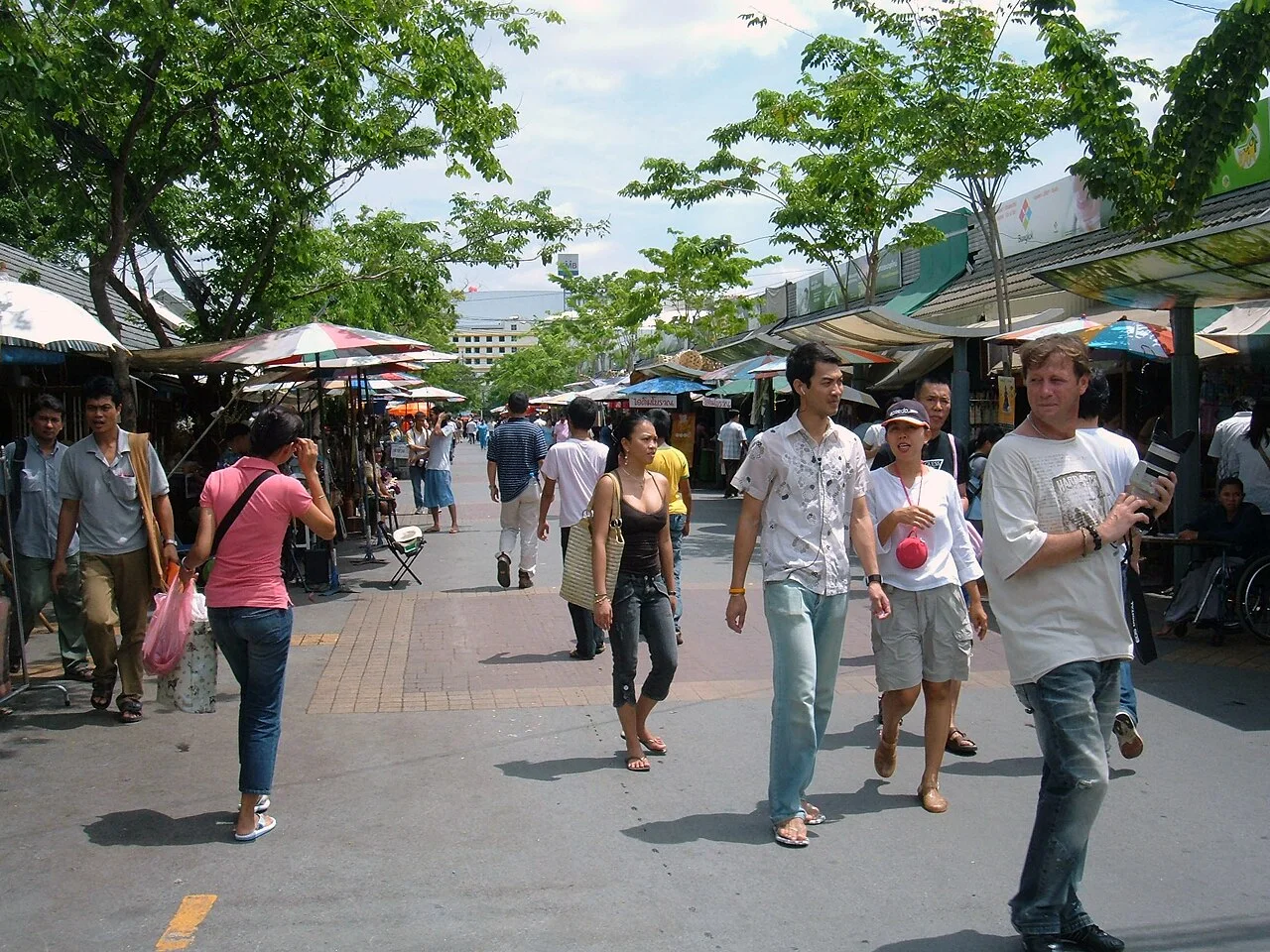
Leave a suitcase at your accommodation when possible. Rolling luggage catches on uneven paving and blocks passing space inside the rows; that is a practical reason to travel light, rather than a market-wide baggage ban. If using paid storage, choose a facility whose compartment fits your bag and read the displayed collection hours and tariff before locking it.
Shipping services can arrange overseas delivery for purchases. Treat packing and freight as a separate cost from the goods: get an itemised quote with the destination, dimensions, insurance and delivery terms before paying for bulky furniture or art. Import duty and destination restrictions can make a low stall price an expensive purchase.
Food, toilets and a break from the heat
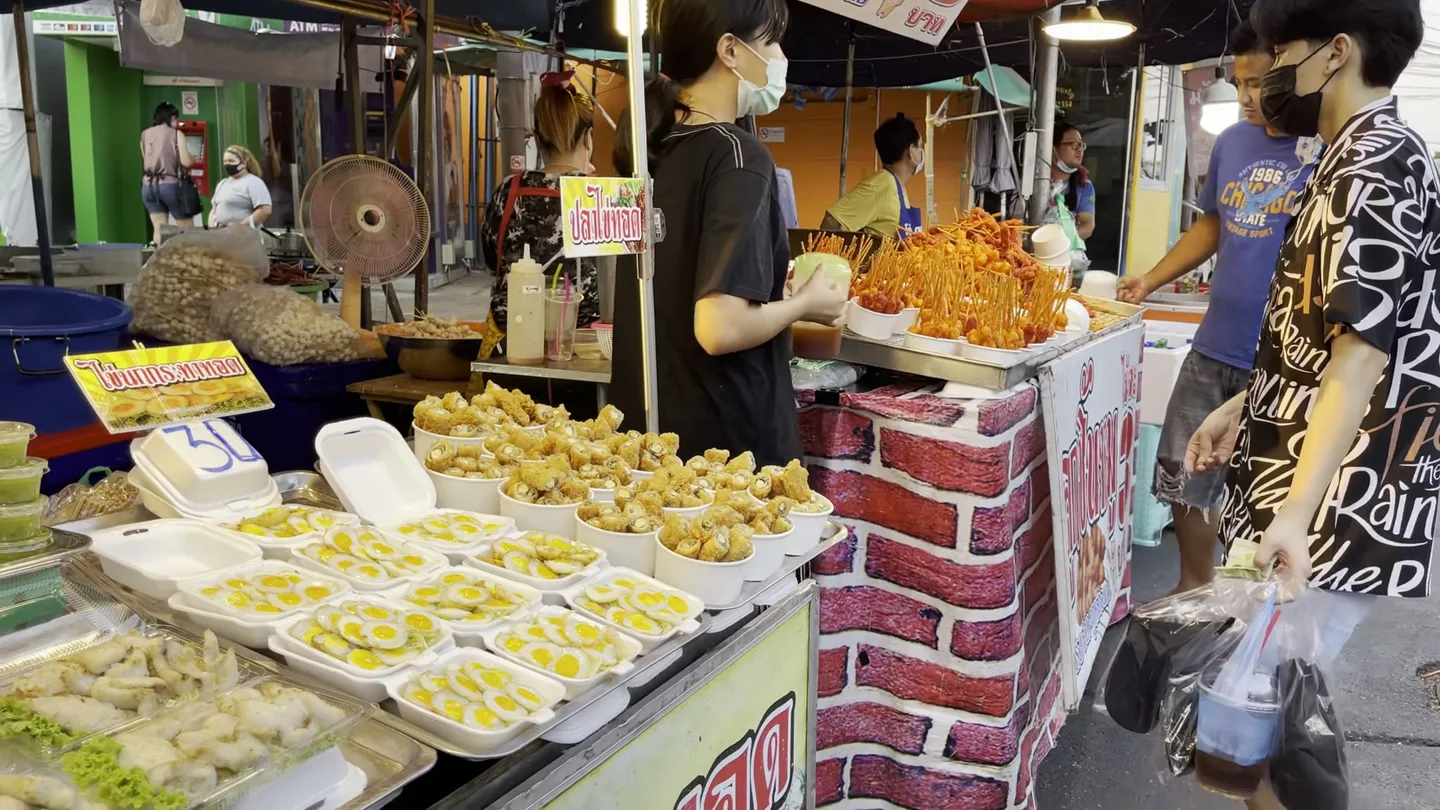
Food and drink sellers are spread among the shops, so a meal need not require crossing the entire market. Look for cooked-to-order dishes, grilled skewers, fruit and coconut ice cream. Ask the portion price before ordering; a coconut shell with toppings can be priced differently from a plain serving. The Bangkok street-food guide helps identify dishes beyond the familiar pad thai.
For a seated food stop outside the shopping lanes, use Or Tor Kor Market across Kamphaeng Phet Road. From inside Kamphaeng Phet station, Exit 3 serves Or Tor Kor. MIXT Chatuchak and JJ Mall beside the market offer indoor shopping and a chance to cool down.
Public toilets are available in the market. Bring coins and tissues for facilities with an attendant; read the charge at the entrance rather than relying on one fee for every toilet. Locate a toilet before taking a child deep into the shopping lanes.
Wear ordinary light clothing and walking shoes, carry water and keep your phone and wallet in a zipped bag. Covered lanes provide shade but can hold heat; plan a seated indoor break if you start to feel unwell. Use the Thai Meteorological Department forecast and warnings when deciding how much outdoor walking to plan.
Wheelchair access and visiting with children
Kamphaeng Phet station has a lift and ramp at Exit 2. The BEM station guide lists the exits and accessibility facilities. Follow the lift signs within the station; ask station staff for assistance if the lift is unavailable.
Step-free access out of the station does not describe every shop. Wider internal roads give more passing room, while side lanes can have thresholds, uneven surfaces and merchandise narrowing the route. A wheelchair user may be able to browse a shop from its entrance while a companion goes inside. Allow space to turn back before entering a tight row.
A compact folding stroller is easier to manage than a wide travel system, but folding it means carrying both the stroller and the child. Keep a family visit short enough to allow a meal and a rest. Put an adult’s phone number with the child and take a photo showing what they are wearing that day.
What to combine with the market
Chatuchak Park is beside the market and suits a walk once you have finished shopping. Queen Sirikit Park offers another green-space option nearby. Use the nearest gate to the place you want to visit; a walking time from one corner of Chatuchak says little about the walk from another.
Or Tor Kor or JJ Mall fits after a morning browse without another train journey. For a different kind of weekend market, Khlong Lat Mayom has food and canals, but it is a separate cross-city trip. Save it for another outing if you want to spend time shopping here.
If your available hours are after dinner, Yaowarat Road is a better fit for a food-led evening than arriving at Chatuchak as its daytime sellers pack up.
From Sanam Luang to Chatuchak
The market’s predecessors traded at Sanam Luang near the Grand Palace and at other central Bangkok sites. The move to Chatuchak in 1982 gave the market its permanent northern location, on a 35-acre site. Clothes, crafts, household goods and art now share a place that still serves both everyday shoppers and visitors looking for something to take home.
Questions before you buy
Can a visitor use Thai QR payment?
A foreign card in a phone wallet does not automatically work with a shop’s Thai bank QR code. Use it only if your bank or payment app explicitly supports that network; otherwise offer cash or ask whether the seller takes cards.
What if the seller has only one of the item I want?
Ask whether more stock can be ordered and agree the collection or delivery arrangements in writing. Pay attention to colour, size and quantity on the receipt when the goods will be supplied later.
Should I buy a live plant to take overseas?
Only after establishing the destination’s plant-import requirements and any Thai export documents for that species. Soil and living plants can be restricted even when they are sold openly. A ceramic planter is a simpler souvenir for a traveller without the required paperwork.
Reliability & freshness
Keep exploring
Moca BangkokICONSIAMKhlong Lat Mayom Floating Market